Tagged: Libya

Obama and Hillary Knew About Benghazi Attack Months In Advance; And Did Nothing

American Patriot

Posted by:

Posted date:  November 04, 2013

benghazi-blood-300x225Last week, on a special episode of 60 Minutes, CBS revealed that the Obama administration knew for months in advance that the attacks on Benghazi of last year were eminent, yet they still chose to do nothing.

Following is the transcript between CBS’s Lara Logan and U.S. Army Green Beret Commander, Lieutenant Colonel Andy Wood. Wood was one of the top American security officials in Libya. He was based in Tripoli and he met with U.S. Ambassador Christopher Stevens every day. Ambassador Stephens and three other Americans were murdered in the attack. The conversation picks up after Wood tells Logan that the terrorists posted online that they were going to attack the Red Cross, then the British, and then the Americans at Benghazi.

Andy Wood: We had one option: “Leave Benghazi or you will be killed.”

Lara Logan: And you watched as they–

Andy Wood: As they did each one of those.

Lara Logan: –attacked the Red Cross and the British mission. And the only ones left–

Andy Wood: Were us. They made good on two out of the three promises. It was a matter of time till they captured the third one.

Lara Logan: And Washington was aware of that?

Andy Wood: They knew we monitored it. We included that in our reports to both State Department and DOD. I made it known in a country team meeting, “You are gonna get attacked. You are gonna get attacked in Benghazi. It’s gonna happen. You need to change your security profile. Shut down operations. Move out temporarily. Ch– or change locations within the city. Do something to break up the profile because you are being targeted. They are– they are– they are watching you. The attack cycle is such that they’re in the final planning stages.”

Lara Logan: Wait a minute, you said, “They’re in the final planning stages of an attack on the American mission in Benghazi”?

Andy Wood: It was apparent to me that that was the case. Reading, reading all these other, ah, attacks that were occurring, I could see what they were staging up to, it was, it was obvious.

We have learned the U.S. already knew that this man, senior al Qaeda leader Abu Anas al-Libi was in Libya, tasked by the head of al Qaeda to establish a clandestine terrorist network inside the country. Al-Libi was already wanted for his role in bombing two U.S. embassies in Africa.

So there you have it. Proof, straight from the mouth of a man in charge of security. Obama and Hillary Clinton knew the attack was imminent, yet they still chose to do nothing.

Kidnapped Libya PM Ali Zeidan ‘Is Released’

Sky News

10:35am 10th October 2013


Libya‘s Prime Minister Ali Zeidan has reportedly been freed after being kidnapped by scores of gunmen in a pre-dawn raid.

He was earlier reported to be in “good health and being treated well” after he was taken from a luxury Tripoli hotel where he lives.

Mr Zeidan was being held at the interior ministry’s anti-crime department, said an official there, after being seized by up to 150 armed men who arrived at the Corinthia Hotel in pick-up trucks.

Witnesses said a large group of them entered the building, some stayed in reception while others headed to the 21st floor where Mr Zeidan was staying.

The gunmen scuffled with the prime minister’s guards before they seized him and led him out at around 5.15am (local time), said the witnesses, adding he offered no resistance while he was being led away.

Two of his guards were also taken. The security pair were beaten up but later released, another official said.

The government had said the PM was taken to an unknown location after being kidnapped by former rebels.

Mr Zeidan’s abduction reflected the weakness of the government, which is virtually held hostage by powerful militias, many of which are made up of Islamic militants.

A group of ex-rebels said it had ‘arrested’ Mr Zeidan after US Secretary of State John Kerry confirmed Libya’s role in the US capture of alleged al Qaeda leader Abu Anas al Libi.

A spokesman for the group, known as the Operations Room of Libya’s Revolutionaries, said: “His arrest comes after … (Kerry) said the Libyan government was aware of the operation.”

The militia group, which had been hired by the government to provide security in the city, said it had seized Mr Zeidan “on the prosecutor’s orders”.

The premier “was arrested under the Libyan penal code… on the instructions of the public prosecutor”, it said, adding he was detained for “crimes and offences prejudicial to the state” and its security.

Sky’s Foreign Affairs Editor Tim Marshall said: “If this claim is true, it would appear that the prime minister of Libya has been detained by a faction that answers nominally to part of his own government.”

The public prosecutor’s office said it had issued no such warrant for Zeidan’s arrest.

Sky sources said the man believed to be behind the abduction is Abu Obeiida, who is thought to have taken over the militia group.

Foreign Secretary William Hague said he condemned the abduction of the PM and called for his immediate release.

The former rebel group appeared to post a warning of its intentions on Facebook on Monday.

It said it “holds everyone who is involved in co-operating with foreign intelligence” responsible for the “kidnap” of al Libi and “will pursue them and bring them to justice”.

Two years after a revolution toppled Libya’s Muammar Gaddafi, the fragile central government has been struggling to contain tribal militias and groups of former rebels who spearheaded the uprising.

Marshall said: “The prime minister of Libya’s jurisdiction runs about to the end of his hotel corridor and then stops because there is no real government, certainly in the sense that we understand it.

“It is a lawless place that is falling apart into different factions, tribes, regions, areas and groups. The fact this man has been detained does not alter the trajectory of Libya’s spiral into chaos.

“What is very important about the fact that the PM can be taken from his hotel by armed men is symbolic of how bad things have got.”

There has been anger among militant groups over the US special forces operation on Saturday that seized al Libi, whose family met Mr Zeidan hours before the PM’s abduction.

Several groups accused the government of colluding in or allowing the weekend raid, though the government denied having any prior knowledge of the operation.

Al Libi is suspected of being involved in the twin bombings of US embassies in Nairobi, Kenya, and Dar es Salaam, Tanzania in 1998.

At the weekend, he was taken off the street in Tripoli and whisked away to a US warship in the Mediterranean.

Libyan prime minister kidnapped


The Guardian home

Thursday 10 October 2013 08.10 BST

Ali Zeidan taken from hotel in Tripoli by gunmen and driven away to an undisclosed location, government confirms
Libyan PM Zeidan seized by gunmen – live updates

Libya PM Ali Zeidan

Ali Zeidan, the Libyan prime minister. Photograph: Abdeljalil Bounhar/AP

Armed men have kidnapped the Libyan prime minister, Ali Zeidan, from the hotel in Tripoli where he lives.

“The head of the transitional government, Ali Zeidan, was taken to an unknown destination for unknown reasons,” the Libyan government said on its website, attributing the kidnapping to a group of men believed to be former rebels.

The abduction early Thursday comes amid anger among Libya‘s powerful Islamic militant groups over the US special forces raid on Saturday that seized a Libyan al-Qaida suspect known as Abu Anas al-Libi. Several groups accused the government of colluding in or allowing the raid, though the government denied having any prior knowledge of the operation.

Hours before the abduction Zeidan had met with al-Libi’s family, the Associated Press said.

Abu Dhabi-based Sky News Arabia quoted Libyan security sources as saying that Zeidan was seized from the hotel and taken to an unknown destination. Dubai-based al-Arabiya carried a similar report.

According to CNN, armed rebels escorted Zeidan from the Corinthian Hotel in Tripol and took him away in a car. The news service quoted a hotel clerk as saying there was no gunfire and the gunmen “caused no trouble”.

Zeidan’s office initially denied the abduction on Facebook but later stated the denial was made at the order of the kidnappers.

The Libyan cabinet held an emergency meeting on Thursday morning, headed by Zidan’s deputy, Abdel-Salam al-Qadi.

Reflecting the divided and chaotic state of Libya’s government, Zidan’s seizure was depicted by different sources as either an “arrest” or an abduction

Abdel-Moneim al-Hour, an official with the country’s Anti-Crime Committee, told the Associated Press that Zidan had been arrested on accusations of harming state security and corruption. But the public prosecutor’s office said it had issued no warrant for Zidan’s arrest.

A government official said two guards abducted with Zidan were beaten but later released.

US state department spokeswoman Jen Psaki, travelling in Brunei with the secretary of state, John Kerry, said: “We are looking into these reports and we are in close touch with senior US and Libyan officials on the ground.”

French judges drop charges against Sarkozy

AFPBy Odile DUPERRY
7th October 2013
France's then-president Nicolas Sarkozy visits social welfare facilities in Bordeaux, southwestern France, on November 15, 2011

View Photo

AFP/AFP/File – France’s then-president Nicolas Sarkozy visits social welfare facilities in Bordeaux, southwestern France, on November 15, 2011

Nicolas Sarkozy’s hopes of a comeback to the frontline of French politics were given a major boost on Monday when corruption charges against the former president were dropped.

The decision removes the biggest obstacle to a career revival for the 58-year-old, although he remains embroiled in a string of separate scandals that could yet prevent his return to the fray.

The charismatic right-winger had been facing a lengthy trial process, a potential three-year prison term and a ban from public office after being formally charged in March as part of a wide-ranging probe into the financing of his successful 2007 election campaign.

But after six months of deliberations, the two judges in charge of the case have decided to send only 10 of the 12 accused in the case for trial and to drop proceedings against Sarkozy and one other suspect, tax lawyer Fabrice Goguel, judicial sources told AFP.

The specific charge against Sarkozy was that he took advantage of France’s richest woman, L’Oreal heiress Liliane Bettencourt, by accepting cash from her when she was allegedly too frail to know what she was doing. Bettencourt, now 90, has suffered from dementia since 2006.

Amongst the six who will face trial is Eric Woerth, a former minister who was Sarkozy’s campaign treasurer and who stands accused of accepting envelopes stuffed with cash from Bettencourt’s right-hand man, Patrice de Maistre.

The decision to drop the charges against Sarkozy is in line with a recommendation from the public prosecutor in the case, who had advised the judges that convictions were unlikely to be secured against six of the 12 accused, including the former president.

That advice was initially ignored by the two judges, prompting allegations of political bias, and it had been widely assumed that Sarkozy would be sent for trial following the failure last week of an attempt by his lawyers to have the charges dismissed on procedural grounds.

It emerged on Monday however that the Bordeaux prosecutors had warned the judges that they would appeal against any decision to send Sarkozy for trial, raising the prospect of a further delay in concluding a probe that began while Sarkozy was still in office.

Sarkozy stepped back from politics after losing last year’s presidential vote to Socialist candidate Francois Hollande, concentrating instead on making money on the international conference circuit and spending time with his former supermodel wife, Carla Bruni, and their young daughter.

But he has repeatedly hinted at a comeback in time for the 2017 election, most notably saying earlier this year that he may be obliged to return to “save” France from a Socialist-created economic disaster.

Polls suggest he would be welcomed back by supporters of his UMP party, the main opposition, if not necessarily by the rest of the electorate.

The decision to drop the campaign finance charges does not mean Sarkozy is clear of legal problems which could yet wreck his comeback hopes.

He is separately being investigated over claims he accepted up to 50 million euros ($65 million) in cash from former Libyan dictator Moamer Kadhafi for the 2007 campaign.

Sarkozy has been implicated in a number of other scandals, the most serious of which centres on an allegation that he helped organise kickbacks from a Pakistani arms deal to finance the 1995 presidential campaign of former premier Edouard Balladour.

He is also being probed over allegations that, while president, he used public funds to pay for party political research and handed out contracts for polling to a political crony.

More indirectly, Sarkozy has been caught up in the ongoing investigation into a huge payout made by the French state to disgraced tycoon Bernard Tapie.

Prosecutors suspect Tapie received preferential treatment in the case in return for his support for Sarkozy in the 2007 election.

Op-Ed: Libya still trying to eliminate its chemical weapons stocks

Sep 23, 2013
Tripoli –  Libya signed on to the Chemical Weapons  Convention nine years ago but it is still trying to destroy the remainder of its  stocks. It has managed to destroy 95 per cent of its mustard gas.

   In 2004 in order to remove its image as a pariah state or  perhaps it feared that it might be invaded because it had weapons of mass  destruction, Libya under Gadaffi signed the Chemical Weapons Convention. At the  time, the regime said it had 13 tonnes of mustard gas but had destroyed the  means to deliver it. Following the signing, Gadaffi under OPCW experts   destroyed over half of his mustard gas and 40 per cent of chemicals used to  manufacture, and 3,550 bombs used to deliver the gas.

In 2011 the uprising against  Gadaffi interrupted the process. Work resumed under the new government in 2012.  Colonel Ali Chikhi, spokesperson for the Libyan army staff  said: “The process of elimination is being conducted step-by-step, with the  latest stage of the destruction of chemicals taking place between December, 2012  and May, 2013. Libya has destroyed 95 percent of its mustard gas stocks and is  on course to eliminate the remainder by 2016 at the latest.Chemical substances  stored in warehouses are strictly monitored and subject to draconian controls by  Libya and the international community” .

The Foreign Minister Mohamed  Abdelaziz said that Libya has forged an agreement with the US to provide  technical help in destroying the chemicals. The experts were expected in Libya  within the next few days. The United States has agreed to pay 80 per cent of the  cost of the operation. Libya also has stocks of yellowcake or concentrated  uranium which for now will not be touched. Libya is trying to determine if the  uranium can be used for nuclear energy purposes.  With the help of the  International Atomic Energy Agency inspectors, the stock has been secured.

The United States and Russia both became active in destroying  their chemical weapons under the Convention in 1997. Both set a deadline of  April 2012 for destroying their stockpiles. Neither met the deadline but the US  at 90%  completion is far ahead of Russia. The US now says it will finish its destruction far in the  future: The Pentagon intends by 2023 to wrap up dismantlement of the U.S.  chemical stockpile, which once contained nearly 30,000 tons of warfare  agent.

The Russia US plan calls for Syria to destroy its chemicals and  weapons by the middle of 2014. Syrian President Assad said last week that “it  needs a year, or maybe a little bit more and $1 billion for Syria to surrender  its chemical weapons.”  If Syria does not comply, it could face serious  consequences including a possible military attack. There is no UN resolution  pending to punish the failures of the US, and Russia who have missed their  deadline and have now spent over a decade ridding themselves of their  stockpiles. The US is now looking at 2023 to finish.


Benghazi facility ‘unlike any other in recent history’

WND EXCLUSIVE
By Aaron Klein

Wednesday, September 18, 2013

Newly released report presents more evidence of secret activities

US-consulate_2633824b

NEW YORK – The U.S. facility in Benghazi was unique in almost every aspect as  far as security was concerned, according to the State Department’s Libya desk  officer, Brian Papanu.

“Well, Benghazi was definitely unique in almost every – I can’t think of a  mission similar to this ever, and definitely in recent history,” Papanu  stated.

 The diplomat’s quotes were contained in a newly  released 100-page report on the Benghazi attack by the House Oversight and  Government Reform Committee.

Informed Middle Eastern security officials, meanwhile, have told WND on  multiple occasions that the Benghazi mission was a planning headquarters for  coordinating aid, including weapons distribution, to jihadist-led rebels.

Regarding the unusual nature of the U.S. facility in Benghazi, the House  report stated: “Documents and testimony obtained by the Committee during the  course of its investigation show that the ad hoc facility in Benghazi, rather  than being an example of expeditionary diplomacy, was instead an expedient way  to maintain a diplomatic presence in a dangerous place.

Are  President Obama’s actions surrounding the Benghazi disaster grounds for  impeachment? Aaron Klein makes the case in “Impeachable Offenses: The Case to  Remove Barack Obama from Office,” available now, autographed, at WND’s  Superstore

“The State Department was operating a temporary residential facility in a  violent and unstable environment without adequate U.S. and host nation security  support.”

Lee Lohman, the executive director of the Near Eastern Affairs Bureau,  further testified: [R]emember that Benghazi, I’m not sure that we – I’m trying  to think back. I mean, we’ve evacuated from any number of places, but I’m not  sure we’ve ever gone into something in such an expeditionary way as this by  ourselves without having military along with us.”

The unusual lack of adequate security presents further evidence that secret  activities took place inside the U.S. facility. Any large security presence  would have drawn more attention to the shabby residential facility.

Perhaps even more perplexing than the lack of a significant U.S. security  team in such a threat environment was the presence of the February 17 Brigade,  which provided external security to the attacked Benghazi U.S. compound,  including the villa where murdered Ambassador Chris Stevens lived when he was in  Benghazi.

The February 17 Brigade is part of the al-Qaida-linked Ansar Al-Sharia, a  militia that advocates the strict implementation of Islamic law in Libya and  elsewhere and that took credit for previous attacks against other diplomatic  posts in Benghazi.

Ansar al-Sharia initially used Internet forums and social media to claim  responsibility for the Sept. 11, 2012, Benghazi attack. Later, a spokesman for  the group denied it was behind the attack.

Witnesses told reporters they saw vehicles with the group’s logo at the scene  and that gunmen fighting at the compound had stated they were part of Ansar  al-Sharia.

Some witnesses said they saw Ahmed Abu Khattala, a commander of Ansar  al-Sharia, leading the attack. Contacted by news media, Khattala denied that he  was at the scene.

More evidence of ambassador’s secret activities

According to the Middle Eastern security sources who have spoken to WND,  arming efforts at the U.S. facility shifted focus to aiding the insurgency  targeting President Bashar al-Assad’s regime in Syria after the fall of Libyan  dictator Muammar Gadhafi.

Two weeks after the Sept. 11, 2012, Benghazi attack, WND  broke the story that murdered U.S. Ambassador Christopher Stevens himself  played a central role in arming rebels and recruiting jihadists to fight Assad,  according to Egyptian security officials.

In November 2012, Middle Eastern security sources further described both the  U.S. mission and nearby CIA annex in Benghazi as the main intelligence and  planning center for U.S. aid to the rebels, which was being coordinated with  Turkey, Saudi Arabia and Qatar.

Many rebel fighters are openly members of terrorist organizations, including  al-Qaida.

The information may help determine what motivated the deadly attacks in  Benghazi.

In June, a Libyan weapons dealer from the February 17 Brigade – the group  hired to provide security to the U.S. mission in Benghazi – told Reuters he has  helped ship weapons from Benghazi to the rebels fighting in Syria.

The detailed account may provide more circumstantial evidence the U.S.  Benghazi mission was secretly involved in procuring and shipping weapons to the  Syrian opposition before the deadly attack last September that killed the U.S.  ambassador and three other Americans.

In the interview  with Reuters, Libyan warlord Abdul Basit Haroun declared he was behind some  of the biggest shipments of weapons from Libya to Syria. Most of the weapons  were sent to Turkey, where they were then smuggled into neighboring Syria, he  said.

Haroun explained he sent a massive weapons shipment from the port in Benghazi  in August 2012, days before the attack on the U.S. compound. The weapons were  smuggled into Syria aboard a Libyan ship that landed in Turkey purportedly to  deliver humanitarian aid.

Ismail Salabi, a commander of the February 17 Brigade, told Reuters that  Haroun was a member of the Brigade until he quit to form his own brigade.

Coordinating with rebels

Haroun told Reuters he runs the weapons smuggling operation with an  associate, who helps him coordinate about a dozen people in Libyan cities  collecting weapons for Syria.

In May, WND  reported the U.S. Benghazi compound was involved in weapons collection  efforts.

In a largely unnoticed speech to a think tank seven months before the  Benghazi attack, a top State Department official described an unprecedented  multi-million-dollar U.S. effort to secure anti-aircraft weapons in Libya after  the fall of Gadhafi’s regime.

The official, Andrew J. Shapiro, assistant secretary of state for the Bureau  of Political-Military Affairs, said U.S. experts were fully coordinating the  collection efforts with the Libyan opposition.

He said the efforts were taking place in Benghazi, where a leading U.S.  expert was deployed.

In January, former Secretary of State Hillary Clinton confirmed the efforts  when she told Congress the CIA was leading a “concerted effort to try to track  down and find and recover … MANPADS” looted from Gadhafi’s stockpiles.

Haroun did not mention any U.S. involvement in his weapons dealings.

However, last March the  New York Times reported the CIA had worked with rebel commanders to coordinate  the shipment of arms to the Syrian rebels since early 2012.

Last year, Business  Insider alleged a connection between Stevens and a reported September  shipment of SA-7 MANPADS and rocket-propelled grenades from Benghazi to Syria  through Turkey.

Syrian rebels then reportedly began shooting down Syrian military helicopters  with SA-7s.

Stevens’ last meeting on the night of the Benghazi attack was with Turkish  Consul General Ali Sait Akin.

One source told Fox News that Stevens was in Benghazi “to negotiate a weapons  transfer in an effort to get SA-7 missiles out of the hands of Libya-based  extremists.”

‘Largest weapons shipment’

Fox News may find another one of its  exclusive reports vindicated.

In October 2012, Fox News reported the Libyan-flagged vessel Al Entisar,  which means “The Victory,” was received in the Turkish port of Iskenderun, 35  miles from the Syrian border, just five days before Stevens was killed.

The shipment, disguised as humanitarian aid, was described as the largest  consignment of weapons headed for Syria’s rebels.

Fox News reported the shipment “may have some link to the Sept. 11 terror  attack on the U.S. Consulate in Benghazi.”

That shipment seems to be the one described by Haroun in his Reuters  article.

Both Haroun and his associate described an August 2012 shipment with weapons  hidden among about 460 metric tons of aid destined for Syrian refugees.

A recent U.N. report appears to confirm that weapons were hidden in the Al  Entisar.

A U.N. Panel found that the loading port for the shipment was Benghazi, that  the exporter was “a relief organization based in Benghazi” and the consignee was  the same Islamic foundation based in Turkey that Haroun told Reuters had helped  with documentation.

Blast Damages Libyan Foreign Ministry Building in Benghazi

BY:

September 11, 2013 8:09 am


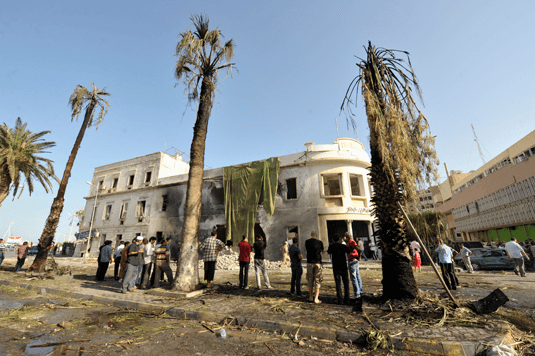
People stand near a Libyan Foreign Ministry building in Benghazi after an explosion in Benghazi September 11, 2013. REUTERS/Esam Omran Al-Fetori

BENGHAZI, Libya (Reuters) – An explosion damaged a Libyan foreign ministry building in Benghazi, local officials said on Wednesday, the first anniversary of the attack on the U.S. consulate in the country’s second largest city.

Officials said the car bomb exploded at dawn, badly damaging the ministry office and several other buildings in the center of Benghazi, but there were no immediate reports of casualties.

“The car had a large amount of explosives and was placed just next to the building,” said Abdullah Zaidi, a local security official told Reuters.

Two years after the revolt that toppled Muammar Gaddafi, Libya is deeply split along regional and tribal lines, leaving the central government in Tripoli struggling to control the influence of rival militias and radical Islamists.

The central government is also trying to end strikes by oil workers and armed guards at oil installations that have paralyzed the North African state’s crude production.

Four Americans including the U.S. envoy to Libya were killed in an attack on the consulate in Benghazi a year ago. Washington initially said the assault had grown out of anti-Western protests. But it later turned out that Islamist militants were the perpetrators, marking the 11th anniversary of al Qaeda’s September 11 attacks on the United States.

Gowdy alleges massive Benghazi cover-up

By Jonathan Easley                                                                                –                                                                                    08/02/13  07:46 AM ET

Rep. Trey Gowdy (R-S.C.) is accusing the Obama administration of a  massive cover-up in the deadly Benghazi, Libya, terrorist attack, saying it  was “dispersing” witnesses around the country and changing their names in  an effort to hide the truth about what happened.

In an interview Thursday with Fox News host Greta Van Susteren, Gowdy said  the administration is “changing names, creating aliases” of U.S. agents who were  in Benghazi on the night of the Sept. 11, 2012, attacks.

“Stop and think what things are most calculated to get at the truth?  Talk to people with first-hand knowledge. What creates the appearance  or perhaps the reality of a cover-up? Not letting us talk with people  who have the most amount of information, dispersing them around  the country and changing their names,” Gowdy said.

According to a CNN  report released on Thursday, “dozens” of CIA operatives were on the  ground at the U.S. diplomatic annex in Benghazi during the attack that  ended with the deaths of Ambassador Christopher Stevens and three other  Americans.

The report says that Langley is taking extreme measures — including  conducting monthly polygraph tests — to hide the agency’s operations in  Benghazi and northern Libya at the time of the attack.

The CIA denies the report.

“We are not aware of any CIA employee who has experienced  retaliation, including any non-routine security procedures, or who has  been prevented from sharing a concern with Congress about the  Benghazi incident,” said spokesman Dean Boyd.

The CNN report adds fuel to an investigation that had otherwise focused  on the State Department.

On Thursday, Rep. Darrell Issa (R-Calif.), the chairman of the House  Oversight panel, subpoenaed State Department documents detailing the inner  workings of the independent board that probed the September attack
Related articles