US authorities have presented a plan for the mass use of drones in American airspace. Though there have been few objections to the move so far, a global government surveillance drone program is likely to raise privacy concerns later on.
The US Federal Aviation Administration (FAA) has presented a detailed plan for drones to roam across American skies within the next two years.
The plan sets September 2015 as a deadline for integrating UAVs into US airspace, and six possible drone test sites will be selected out of 26 proposed ones by the end of 2013.
The move has been continuously lobbied by the trade group Aerospace Industries Association, which expects great demand for civilian-use drones, including for agriculture, firefighting, weather forecast and tracking wildlife.
Within the next five years, after appropriate regulations are introduced, whole 7,500 small UAVs will be operating in US airspace, FAA Administrator Michael Huerta said at an aerospace news conference in Washington on Thursday.
Huerta outlined the ultimate goal of the American drone industry: global leadership that could enable the US to set standards for the industry worldwide.
“We recognize that the expanding use of unmanned aircraft presents great opportunities, but it’s also true that integrating these aircraft presents significant challenges,” Reuters quoted Huerta as saying. He added that US aviation regulations and safety rules would remain a “gold standard” for the rest of the world “to maintain our position of global leadership.”
“We have operational goals and safety issues we need to consider as we expand the use of unmanned aircraft,” Huerta said.
At the same news conference, AIA President Marion Blakey promised that UAVs would bring an “enormity of benefits” to American society and that unmanned aircraft represent “America’s next great aviation frontier.”
According to industry forecaster Teal Group, the estimated $6.6 billion spent worldwide on drone research and development in 2013 will grow to $11.4 billion in 2022, AP reported.
True beneficiaries of drones used in America
The move to use drones widely inside the US had been long expected after drones were introduced into the US Army.
Drones have some clear advantages over fixed surveillance cameras on lampposts and at other locations, as they require the video streams from CCTVs to be processed. For instance, drones can always be focused on the desired objects at the operators’ will at any given time, and drones are cost-effective mobile tools in America’s vast low-rise suburbia.
The FAA previously claimed it has no interest in letting weaponized UAVs, like the missile-equipped Predator, into US airspace anytime soon.
So far nobody is talking about armed UAVs prowling US city skylines, but officials’ ideas about drone data retention has alarmed privacy advocates in the country.
Huerta shared some interesting statistics on who is using drones in the US the most. He mentioned that apart from synoptics, environmental specialists and educational institutions, there are about 80 law enforcement agencies that operate small size surveillance drones, with the FAA granting each of them public use waivers on a case-by-case basis.
“If we’re going to take full advantage of the benefits that we’re talking about from these technologies, we need to be responsive to public concerns about privacy,” Huerta said.
Reportedly, not only the FAA, but also Pentagon, the Department of Homeland Security (DHS) and the Department of justice are taking part in a multi-agency group that has also released a comprehensive plan accelerating integration of UAVs into US national airspace. All data gathered by the six test sites will go straight to that interagency group, Huerta said.
The test drone sites will have to comply with federal and state privacy laws, account for collected data and present annual reviews on privacy practices, Huerta said.
“It’s crucial that as we move forward with drone use, those procedural protections are followed by concrete restrictions on how data from drones can be used and how long it can be stored,” said Christopher Calabrese, legislative counsel for the American Civil Liberties Union.
On the Manning Report, Dr. James David Manning interviews Mia Pope, a former high school acquaintance of B. Hussein Obama, whom she knew as Barry Soetoro. She said she was not really friends with Barry, nobody really was, that he liar who used people.
Mia was born in 1963 in California, but moved to Hawaii as an infant. She met Barry Soetoro in 1977 at the age of 13 or 14. They were both members of a group that just hung out at the beach in Waikiki. She knew him as a foreign student and never gave it much thought. She was surprised years later when he reemerged under a different name as a candidate for president.
Dr. Manning conducts an informative and interesting interview with Mia, in which she details Barry Soetoro’s character or lack thereof back in his youth. She says she would not have even bothered having a conversation with the Dr. if Obama had changed or were not destroying the country. She says that in light of what is going on, she felt compelled, out of patriotism, to speak up.
She details how it was very well known that Barry was not into girls and his membership in the gay community, particularly around Diamond Head. Barry never exhibited any interest in women, she says, everybody knew he was strictly into men.
According to Pope, Soetoro had a serious cocaine habit and the source of his cocaine was the white men that he had relations with.
She talks about how the two of them really didn’t get along back then, that Barry was clearly a pathological liar. She says that, “every time Barry opened his mouth, the most outlandish stories would come out.” She remembers asking, “Barry, don’t you ever get tired of lying?” She remarks how he would lie about the most self aggrandizing types of things, always something to egotistically boost himself. She recalls how he’d turn on the charm, just to get something from you. She used an example of the way he’d bum cigarettes, as they all did from each other, and then as soon as you gave him one he’d snap and turn away. “Like adding insult to injury”, she said.
It’s a very revealing interview and well worth the time to listen. Mia doesn’t have any interest in writing a book, she says she doesn’t have enough to fill up a book, and she isn’t out to make a name for herself. She says what brings her forward is courage, and a need to speak up regarding the wrongs that are being committed against her nation.
She says that she has no interest in and wouldn’t be discussing his sexual orientation or his drug use if he weren’t still the lying “scumbag” that he used to be. But he is and therefore, out of a sense of duty to her nation, she feels a need to expose the fraud for what he is. Many things don’t add up, such as Soetoro’s admission into the extremely expensive and exclusive Punaho School and the suspicious, still unsolved murders of three gay acquaintances of Obama from the Trinity Church in Chicago.
Perhaps more individuals from Barry’s past will now feel empowered to speak up regarding the curious circumstances. If you take the time to watch the video, you will hear a firsthand account of a person upon which a false presidential persona has been structured.
According to information released at a May 9, 2013 press conference by the families of Navy SEALs killed in an August 2011 helicopter shoot-down in Afghanistan, “military brass prohibited any mention of a Judeo-Christian G-d” and “invited a Muslim cleric to the funeral for the fallen Navy SEAL Team VI heroes who disparaged in Arabic the memory of these servicemen by damning them as infidels to Allah.”
The accusations arose over a “ramp ceremony” held at Bagram Airfield in Afghanistan as flag-draped caskets of the dead soldiers were loaded onto a plane for transport back to the United States. The shocking words of the Muslim cleric, revealed in later translations, were spoken at a memorial service meant to honor those who made the ultimate sacrifice for their country. They were yet another example of the abject disrespect of Christians and Christianity endemic to the Muslim world.
Here at home, Christianity and Christian religious practices are also under attack, but in more subtle ways and under a misinterpretation of the principle of freedom of religion. In the United States, that legal doctrine is cited to marginalize Christian prayer and traditions, while, at the same time, dramatically accommodating and even expanding Muslim religious practices. Myriad examples exist.
During the recent government shutdown, Catholic priests were warned that they could be arrested for celebrating Mass, even if performed on a voluntary basis. Under Secretary of Defense Chuck Hagel’s direction and determination was that priests do not “contribute to the morale” and “well-being” of military personnel.” Thus, offering of the sacraments was prohibited and the Eucharist placed under lock and key. Curiously, no mention was made of curtailing religious freedom for Muslim service members or furloughing imams.
This prohibition against Christian religious practice is not limited to the military. Police throughout the land also frequently come down hard against Christians. In 2010, a group of students from the Arizona-based Wickenburg Christian Academy were ordered by a police officer to cease their quiet prayers on the steps of the Supreme Court in Washington, D.C. The officer cited a statute that prohibits demonstrations on the steps, but no official policy bars prayer at that location.
In June of 2010, David Wood and two other Christian missionaries were arrested by Dearborn, Michigan police at the annual Arab festival for discussing Christianity on a public sidewalk outside the event. The men, who have since been acquitted, were charged with disturbing the peace and spent the night in jail.
Contrast these incidents with a massive public display of praying Muslims during the annual Muslim Day Parade in New York City. Muslims, who are protected each year during the event by Muslim NYPD officers, are free to engage in mass prayer, even prostrating themselves on the streets of midtown Manhattan. Vehicular traffic halts and participants freely harass non-Muslims who attempt to pass through the area on foot.
Meanwhile, the ACLU has been at the forefront of an extensive effort to ban Christian prayer from public schools under the “separation of church and state” provision of the First Amendment. This is a signature issue for the “civil rights” organization. However, for Muslim prayers, the organization reverses its interpretation and fights for student rights to engage in prayer.
For example, when Carver Elementary School in San Diego instituted a 15-minute prayer period during class time for Muslim students in 2004, the ACLU endorsed the practice. ACLU spokesman Kevin Keenan said the group supported Muslim prayer under the First Amendment’s prohibition against impeding religion. In this way, the ACLU was “honoring constitutional standards for freedom of religion.”
Again in 2010, the ACLU mustered only mild to nonexistent concern when 6th-graders from a Wellesley, Massachusetts’s middle school took a field trip to a local mosque at the Islamic Society of Boston Cultural Center and engaged in prayer. Parents were told that students would learn about the architecture of the building and observe a midday prayer service. But once at the mosque — which is associated with the Muslim Brotherhood, known supporters of Islamic terrorism — students were told by a mosque official that “Allah is the only G-d” and taught how to recite the midday prayer. After being encouraged to join the Muslim men, some of the boys prostrated themselves to Allah.
Meanwhile, in Michigan, Dearborn public schools have a policy of accommodating Muslim prayers at school during school hours, as well as ignoring unexcused absences for Muslims to leave school early for Friday prayers. Yet, in 2009, after a Muslim organization complained about permission slips given to Christian students to attend off-site afterschool Bible study, issuance of the slips was discontinued.
In addition to police, the ACLU, and schools, U.S. courts have also sided with the Islamic religion and against Christianity. In 2001, the Byron Union School District in Byron, California instituted a three-week unit on Islam for 7th-graders. Students took Muslim names, recited Islamic prayers, and celebrated Ramadan. When parents sued the school on the grounds that the course was “officially endorsing a religion,” the U.S. Supreme Court rejected their appeal, leaving intact an earlier ruling by the Ninth U.S. Circuit Court of Appeals that deemed that the unit did not violate the Constitution and had an “instructional purpose.”
In 2009, the same court of appeals upheld a ban by Henry Jackson High School officials in Everett, Washington against an instrumental performance of Ave Maria at a 2006 commencement ceremony. A student futilely challenged the school’s determination that the song was “an obvious religious piece” at a graduation that should be “strictly secular.”
Government entities also bear down on the Christian religion. After allowing baptisms in Sinking Creek in the Ozarks for an almost uninterrupted 50-year span, the National Park Service in August notified Gladden Baptist Church in Salem, Missouri that permits would now be required in advance of baptism ceremonies in the waterway. The requirement was later rescinded in response to the intervention of local Congressman Jason Smith.
And this month, in Ovid, Colorado, the director of a city-owned cemetery initially refused to inscribe the Ichthus or “Jesus fish” on the tombstone of a local preacher’s wife on the grounds that some people might be offended. Despite the fact that the cemetery is filled with headstones inscribed with religious symbols and Biblical verses, city officials refused to come to the family’s aid. The cemetery director defended his position with a logic-defying hypothetical: “What if someone wanted to put a swastika?” — thereby disrespectfully equating a representation of Christ with a symbol associated with Nazi Germany. The city reversed itself only after public outcry and media attention.
The instances listed above make it readily apparent that the First Amendment is often conveniently misinterpreted to buttress the assault on the Christian religion and its expression, practice, and traditions. In this way, Christianity is being insidiously expunged from public life using false legal pretenses. The legitimate interpretation of the provisions of the First Amendment, which include prohibitions against government interference in public religious expression and the establishment of a national religion, has been twisted to prohibit Christian prayer in public places and schools. This is a false reading of “separation of church and state.”
Yet, as the instances listed above and many others illustrate, this interpretation doesn’t apply to “mosque and state.” Freedom of religion has come to mean no freedom for the practice of Christianity but ample freedom to practice Islam. If the war on Christianity in America isn’t halted soon, Barack Obama’s statement that “[w]hatever we once were, we are no longer a Christian nation,” will certainly become a reality.
An Australian bitcoin bank holding over US$1 million of the crypto-currency has been hacked, leaving an unknown number of users with nothing – one of the largest thefts in the currency’s four-year history.
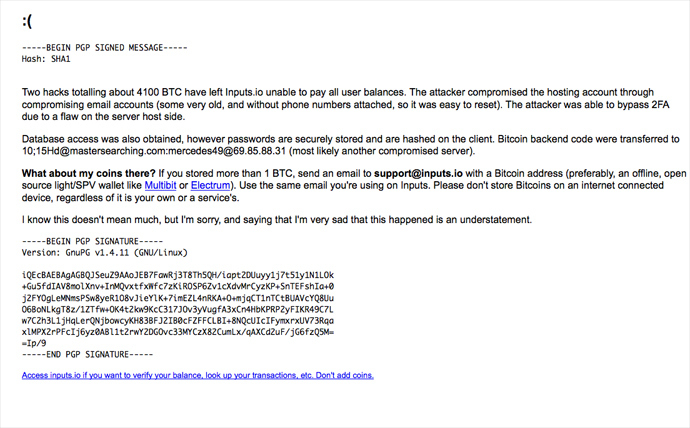
The incident took place on October 26, when the bank was hacked, with 4,100 bitcoins valued at $1.3 million stolen, the service’s operator only known as ‘Tradefortress’ said. He refused to give his name to the press, also stressing he was not much older than 18.
It took the bank’s owner two weeks to notify the affected customers.
Bitcoin is a decentralized, crypto-currency, free from any government or central bank control. Currency is sold and bought at online exchanges, and those transactions can be virtually anonymous.
One bitcoin is currently worth more than $300 on Mt. Gox, the world’s largest bitcoin exchange – up from around $50 in March. There are 11,925,700 million bitcoins in circulation.
The Sydney man offered the service called Inputs.io, which he claimed was “one of the most secure web wallets on the market.” Customers were charged a small fee to keep their bitcoins there.
The site used two-factor authentication and location-based email confirmation, and said the page was started to avert “the hack of bitcoins even if the web server was compromised.”
Some of the hacked money is to be refunded, the operator told Fairfax Media. Tradefortress said he would use 1,000 of his own bitcoins, as well as the money the hackers didn’t steal. “Users are being repaid up to 100 percent depending on the amount (sliding scale), generally 40-75 percent,” Tradefortress said.
The operator indicated the attack was possible due to “a flaw” in the system which allowed the hackers to bypass the protection.
Currently, there’s a sad face emoticon posted online and a notice that reads “I know this doesn’t mean much, but I’m sorry, and saying that I’m very sad that this happened is an understatement.”
The response to the incident has been varied, with some users accusing Tradefortress of making up the whole hacking story to steal their money. He denies the accusation.
Customer Marco Martoccia tweeted (@sheet_metal) that he had lost 4 bitcoins as part of the heist, worth about $1,200. He said he was planning to use bitcoins as a part of the deposit for a house.
Specialists point to a lack of regulation as the main problem with the currency. “The users of Inputs.io were trusting a random person with their money rather than in the real world when you’re dealing with cash, where you trust banks to look after your money,” Ty Miller, director of Australian IT security firm Threat Intelligence, told Fairfax Media.
He recommended storing coins with a strong password on a device not connected to the internet, using hard-drive encryption and antivirus protection.
A spokesman for the Australian Federal Police said to his knowledge, a theft of bitcoins has never been investigated at either a federal or state level.
The operator stated that he is not planning to address police with the matter.
A screenshot grab taken from video uploaded on desmoinesregister.com
Iowan Tyler Comstock was pursued and killed Monday by police after his father called law enforcement to report Tyler had stolen his truck. The cause of young Comstock’s flight? His father’s refusal to buy him cigarettes.
James Comstock said he had denied Tyler’s request for a pack of cigarettes, setting his son off.
“He took off with my truck. I call the police, and they kill him,” James Comstock told The Des Moines Register on Tuesday. “It was over a damn pack of cigarettes. I wouldn’t buy him none.”
“And I lose my son for that.”
The pursuit began on Monday morning, as Ames, Iowa Police Officer Adam McPherson trailed Tyler through red stoplights and flying debris from the truck’s lawn-equipment trailer onto the 33,000-student campus of Iowa State University.
Tyler and police vehicles rammed one another on a grassy expanse of the campus. This led to McPherson calling on Tyler to turn off the ignition. Tyler did not obey the order, revving the engine instead, resulting in McPherson firing seven rounds into the truck.
Comstock was hit in the head and chest, reports say, leading to his death. He was not armed.
Dispatch audio and a dashboard video from McPherson’s cruiser have surfaced since Monday. An unidentified police officer can be heard twice suggesting that McPherson should cease the chase, according to dispatcher audio obtained by the Register.
“If he’s that reckless coming into the college area, why don’t you back off,” the supervisor on the audio can be heard during the first suggestion.
Iowan Tyler Comstock (image from Facebook)
As McPherson was exiting his car moments before firing, the dispatcher can be heard saying, “We know the suspect. We can probably back it off.”
Ames Police Commander Geoff Huff said it has yet to be determined whether McPherson heard the calls to halt the pursuit.
Upon interviewing McPherson and witnesses and reviewing three recordings of the incident, Story County Attorney Stephen Holmes said Thursday the police action was justified
“It is my conclusion that Officer McPherson acted reasonably under very difficult circumstances and McPherson’s use of deadly force was justified,” Holmes wrote in a letter to Ames Police Chief Charles Cychosz.
Video shows Comstock ramming McPherson’s car early in the chase. Comstock proceeded to race at speeds up to 70 miles per hour, “recklessly passing other vehicles,” according to Holmes. Comstock ran at least one red stoplight, narrowly missing other cars, on his way into the campus where the chase ended with Comstock, McPherson and one other officer trading collisions before Comstock stopped his vehicle. McPherson fires shortly after.
Holmes wrote that Comstock had multiple chances to end the confrontation with police.
“In conclusion, McPherson and (another officer) were compelled by Comstock’s actions, which occur under a very fast moving time line,” Holmes wrote. “In watching the videos I can’t help but express my concern that it was only by sheer luck that no one else was seriously injured or killed by Mr. Comstock.”
Tyler’s family remained in shock when speaking with the Register Tuesday. His step-grandfather questioned why police had to pursue so vigorously when they knew the truck and who was in it.
“They’re professionals,” Gary Shepley said. “They’re trained to handle these situations. And if they panic before they even know what’s going on, then ask yourself: What if it was your child?”
And why did McPherson fire into the truck just because Tyler had not turned off the engine? Shepley asked.
“So he didn’t shut the damn truck off, so let’s fire six rounds at him? We’re confused, and we don’t understand,” Shepley said.
Tyler’s family said he had had minor run-ins with the law as a kid and was upset about a recent breakup with his girlfriend, but was attending Bible study and pursuing his General Education Development degree.
“He called me every night, trying to straighten his life out,” James Comstock said.
James added, “He was a smart kid. He made his own computers. He was interested in IT.”
Tyler’s mother, Shari Comstock, remained bewildered as to why McPherson didn’t listen to the dispatcher.
“I just heard the audio of the dispatch. They told (police) to back off,” she said. “Why? Why did they kill him?”
Wei Gan, senior research scientists for the University of Texas Institute for Geophysics (UTIG) found that the injection of carbon dioxide into the ground to extract petrol and natural gas is a contributing factor to a series of recent earthquakes near Snyder, Texas.
In 2012, geophysicists from Stanford University discovered that the process of carbon capture and sequestration (CCS) would cause earth quakes and would not be a viable long-term solution to extracting petrol and natural gas.
Gan’s study states that “underground injection of large volume gas caused earthquakes in Snyder . . . [and] also highlights the point that in other fields, the same rate of injection did not trigger any comparable quakes, reinforcing the idea that underground gas injection does not trigger seismic events in different geological settings.
” The gas fields called the Cogdell and Salt Creek, with the help of the Scurry Area Canon Reef Operators Committee (SACROC), have produced petrol since 1950.
Use of carbon in the 1970s with a process called co2 enhanced oil recovery (CO2-EOR) was increased in 2001; and again in 2004.
Seismic data from 2009 – 2010 was provided by the EarthScope USArray program (ESUSA) which showed that 93 earthquakes had been recorded in the Cogdell region.
The average magnitude of earthquake was 3 on the Richter scale. Other fields near the Cogdell area “have experienced similar CO2 flooding without triggering earthquakes.
It is assumed that “different fields respond differently to CO2 injection and it’s a fact that no other gas injection sites have been associated with earthquakes of magnitude greater than 3 despite the Stanford researchers’ concern.
Writers for the study state: “One possible explanation for the different response to gas injection in the three fields might be that there are geological faults in the Cogdell area that are primed and ready to move when pressures from large volumes of gas reduce friction on these faults.
The other two fields might not have such faults.” There is no consensus on a theory for why earthquakes occur in some places that have been subject to CCS and not others.
Wayne Pennington, interim dean of the College of Engineering at Michigan Technological University (MTU) said : “The bottom line here is, as Gan suspected, carbon dioxide injection under high enough pressures and with high enough volume could induce seismicity just like any other fluid at high enough pressures and with high enough volume. We see (quakes) fairly often with water injection. We know that that can often trigger seismic events and sometimes those can be quite large. So, it isn’t really a surprise that carbon dioxide injection does the same thing. Now the element of mystery is gone.”
Interestingly, in 2012, the Federal Emergency Management Agency (FEMA) released a statement alerting residents that on October 18th at 10:18 am (EST), on the Southeast coast of America, there would be an earthquake drill wherein 1 million residents over 5 states would be participating.
States such as Georgia, South Carolina, North Carolina, Virginia, Maryland, and the District of Columbia will collaborate with “schools, businesses, organizations, government agencies, communities, and households” as well as “many other local, state, federal and volunteer partners.”
All across the US, participation will include: • California • Nevada • Oregon • Washington State • The Southeast Region • Arizona • British Columbia FEMA explained that “it is vitally important for people to have a plan and know what to do during an earthquake.”
They suggest that citizens use the “Drop, Cover and Hold On” approach which consists of dropping to the ground, taking cover under a desk or table, and holding on to the furniture until the quake stops. Called the Great ShakeOut, this drill is directed toward residential homes, schools and organization to “improve preparedness and practice how to be safe during earthquakes.” FEMA cites the strange “earthquake” that occurred in Mineral, Virginia as the reason for the drill.
In August of 2011, mainstream media reported that an earthquake could be felt from Colorado to Washington, D.C. The tremors resulting from a 5.8 magnitude “earthquake” caused “buildings from the Capitol to the White House” to be evacuated, although “there were no immediate reports of damage.”
“The NSA’s backlash from Germany grows, President Obama reportedly told his aids that he’s: “really good at killing” & according to Leon Panetta and John Bolton: “US may have to use military force against Iran”… why?”
Original release: 11/4/13.
On the evening of March 5, 2012, the FBI raided Jeremy Hammond’s apartment in the south side of Chicago. Betrayed by one of his own, Jeremy had no idea that the server used to dump his Stratfor hack had been provided by the Federal Bureau of Investigation.
Before getting caught up in federal conspiracy charges and global intelligence agencies, Jeremy was a kid who stood up for peace and equality. In high school, he organized a student walkout on the day of the Iraq invasion and created a newspaper opposing the war. Throughout his life, Jeremy supported equal rights for minority groups like gays and immigrants while encouraging civil disobedience against the Republican National Convention and Protest Warrior.
As a member of the hacker collective known as Anonymous, Jeremy had been invited to join a proactive cell of Anonymous named LulzSec. Previously known as InternetFeds, Lulzsec had a successful record of hacking into HBGary, Fox Broadcasting Company and Sony Pictures Entertainment among others. But unbeknownst to the other members of LulzSec, on August 15, 2011, Hector Xavier Monsegur, a/k/a “Sabu,” a/k/a “Xavier DeLeon,” a/k/a “Leon” pled guilty to twelve counts of computer hacking conspiracies, bank fraud and identity theft. Facing a maximum sentence of 124 years and six months in prison, Monsegur turned informant and set to work incriminating the other members of LulzSec.
In December 2011, Jeremy hacked into Strategic Forecasting, Inc. or “Stratfor” for short. Stratfor is a private intelligence firm that provides governments and corporations with geopolitical analysis. After extracting Stratfor’s files, Jeremy dumped the sensitive information onto a server that Monsegur had been given by the FBI. While sifting through the data, Jeremy discovered a sinister side to Stratfor’s covert operations.
Several emails from Stratfor’s former CEO George Friedman reveal that Stratfor had been partnering with Shea Morenz, a former Goldman Sachs managing director, to profit from insider trading. Shea Morenz is now President and CEO of Stratfor. As of this writing, the Securities Exchange Commission has not pressed charges against Friedman nor Morenz.
More disclosures reveal Dow Chemical hired Stratfor to spy on protestors and victims of the 1984 Bhopal disaster. While invading the lives of Indian environmental activists, Stratfor also maintained surveillance on The Yes Men. In 2009, The Yes Men produced a film titled The Yes Men Fix the World in which they pose as spokesmen for Dow Chemical and take full responsibility for the Bhopal disaster on BBC World. Although the world rejoiced, Dow’s stocks plummeted.
Even more emails expose The Coca-Cola Company’s insidious decision to hire Stratfor to spy on members of PETA. Corporate executives were concerned animal rights supporters would disrupt the 2010 Olympics. In a statement, the Coca-Cola Company responded to the emails by saying they “consider it prudent to monitor for protest activities at any major event we sponsor”.
The judge presiding over Jeremy’s case is Loretta Preska, Chief Judge of the US District Court for the Southern District of New York. Judge Preska’s husband, Thomas Kalaver, is a victim of Jeremy’s Stratfor hack. As a member of the law firm of Cahill Gordon & Reindel LLP, Kalaver’s email account information was exposed in Jeremy’s hack. Cahill Gordon & Reindel LLP represents several of Stratfor’s clients. By demonstrating to Stratfor and his clients that his wife is willing to punish their enemies to the full extent of the law, Kavaler and his wife could potentially be rewarded for handing down the maximum sentence of 10 years.
Due to her husband’s involvement, Judge Preska has a conflict of interest in this case yet she has refused to recuse herself. The appearance of bias undermines our entire judicial system. Jeremy Hammond deserves a mistrial.
“I believe in the power of the truth. In keeping with that, I do not want to hide what I did or to shy away from my actions.” – Jeremy Hammond
According to the American Cancer Society, the odds you’ll develop cancer in your lifetime are one in two, if you’re a man, and one in three, if you’re a woman.1 But an experimental cancer drug shown to shrink tumors by correcting metabolic oddities in cancer cells shows promise in the fight against this deadly disease. The synthetic drug DCA (dichloroacetate) DOES indeed kill cancer cells, both in the lab and in human beings. However, whether it can reverse tumor growth without harming you in other ways remains to be seen.
“The synthetic drug DCA (dichloroacetate) DOES indeed kill cancer cells, both in the lab and in human beings. However, whether it can reverse tumor growth without harming you in other ways remains to be seen.” – Dr. Joseph Mercola
The first clinical trial, although small, involving patients with brain cancer (glioblastoma) was encouraging, and the results were published in Science of Translational Medicine in 20102 . However, there is still a great deal more work to be done before DCA can be pronounced a safe and effective cancer treatment.
An interesting aspect of DCA is that it’s an inexpensive, non-patentable molecule, which makes it of minimal value to pharmaceutical companies that profit by patenting expensive new drugs. Therefore, clinical trials are slow to get going due to lack of funding by Big Pharma. Researchers must await sufficient money to trickle in from government sources and public donations before moving forward.
In the paragraphs below, my aim is to give you information from both sides of the story—the potential benefits as well as the possible risks.
Rats Fed DCA Showed Dramatic Tumor Regression
The impetus behind most of the DCA research has been cardiologist Evangelos Michelakis of the University of Alberta in Edmonton, Canada. In 2007, Michelakis and his colleagues sparked a firestorm of interest when they announced rats fed DCA showed rapid tumor regression without any apparent side effects. Michelakis has been the first to say these results are preliminary and cautions cancer patients to refrain from running out and buying the drug, prior to clinical trials.
Yet, many desperate cancer patients with few remaining options are doing just that, and side effects ARE being reported.
There are currently three clinical trials involving use of DCA to treat cancer that are currently recruiting participants3. Some of these studies plan to combine DCA with other chemotherapy drugs and radiation, all known to have damaging effects in your body. However, if you have cancer and are tempted to participate, there are some things you should know in order to make an informed decision about the risk versus the benefits of this experimental treatment.
Cancer Cells and Healthy Cells Have Different Metabolic Processes
In order to understand how DCA kills cancer cells, it is necessary to understand a bit about how the cellular metabolism of cancer cells differs from that of your normal, healthy cells. Cancer cells have very different metabolic processes than normal cells, in terms of how they derive their energy.4 It’s a rather complicated distinction, so please bear with me as I try to explain it in the simplest terms possible.
There are two major pathways your cells use to covert sugar into energy: glucose oxidation and glycolysis:
Glucose oxidationis the primary energy metabolism in normal cells and takes place in your mitochondria, which are the little “power plants” inside your cell; it requires the presence of oxygen, as its name suggests. This is why you breathe and your heart beats to circulate oxygen throughout your body. Glucose oxidation is sometimes referred to as cellular respiration.
Glycolysis takes place in your cell’s cytoplasm. It can occur without the presence of oxygen. Glycolysis is less efficient for normal cells, but it is acancer cell’spreferredmeans of energy metabolism, and it depends on the availability of sugar.
So, when your cells are oxygen-starved they have a backup plan. They can extract energy from sugar without the presence of oxygen, by glycolysis.
Pyruvate is required for glucose oxidation. There is an enzyme (pyruvate dehydrogenase kinase, or PDK) that acts as gatekeeper to regulate the flow of pyruvate into the mitochondria. If PDK is active, it suppresses the transport of pyruvate into the mitochondria, and your cell is forced to rely on glycolysis, even if oxygen is available. If PDK is inactive, pyruvate is shuttled into the mitochondria, even if oxygen is low.
Unlike normal cells, cancer cells are masterful at deriving energy from glycolysis—they have very active PDK. The way to make a cancer cell unhappy is by suppressing PDK, forcing the cell to use glucose oxidation, instead of glycolysis. This is called the Warburg theory of cancer, or the Warburg hypothesis5. This is where DCA comes in.
DCA Instigates Mass Suicide among Cancer Cells
DCA suppresses PDK (the mitochondrial gatekeeper), and this fires up the cell’s mitochondria. Not only does this force the cancer cell to abandon its preferred metabolic process, but it flips the cell’s “suicide switch” as well. This happens because mitochondria are the primary regulators of apoptosis, or cellular suicide—they are loaded with sensors that react to abnormalities by pushing the cell’s self-destruct button.
When a cancer cell’s mitochondria realize it’s a cancer cell, it spontaneously kills itself. This is the reason chemotherapy and radiation result in such terrible side effects—your healthy cells actually die much more easily because of this self-destruct button.
The reason cancer is so fast growing is that the mitochondria have been deactivated, so the cells evade apoptosis, as well as being able to grow in the absence of oxygen (glycolysis)6. DCA reverses this.In effect, DCA directly causes cancer cell apoptosis and works synergistically other cancer therapies, such as radiation, gene therapy, and viral therapy. A number of scientific studies have been performed to date, and most are encouraging.
DCA–Cancer Research Review
Most of the studies thus far have been done on cell cultures in the lab (in vitro), as opposed to on cancer patients themselves (in vivo). Yet the results are impressively consistent across the board, suggesting DCA is effective against a wide variety of cancer types. The DCA Site7 has a good list of all clinical studies through 2011.
The study that sparked the DCA excitement appeared in Cancer Cell in January 20078 According to an article in the Edmonton Journal9 in the 2007 rat study, DCA killed lung, breast, and brain cancer cells but left healthy cells alone. The rats’ tumors decreased by up to 70 percent in three weeks of DCA treatment, without negative side effects.
This announcement led to a cyclone of excitement from cancer patients everywhere who scrambled to get their hands on the new “cancer cure,” in spite of warnings from Michelakis himself (and others) against prematurely self-medicating with the compound. Several more studies soon followed, including the first clinical trial2 involving brain cancer patients. In that trial, the research team selected five glioblastoma patients with a particularly aggressive form of brain cancer. They treated them with oral DCA for 15 months.
Tumor tissue was compared before and after DCA treatment in three of the five patients. In all three, there were signs that the tumor growth had slowed, and more cancer cells were undergoing programmed cell death after the treatment with DCA. Unfortunately, one of the five patients died. Another had “debulking” surgery before completing the full course of DCA treatment.Below are some of the other DCA cancer studies, all within the past five years. (Note that none of these involved human subjects.)
Endometrial Cancer: DCA causes apoptosis in endometrial cancer cells.10
Prostate Cancer: DCA produces significant cytotoxic effects in prostate cancer cells11
Breast Cancer: DCA has anti-proliferative properties against breast cancer cells and caused apoptosis of those cells12
Colorectal Cancer: DCA reduced colon cancer tumors by 20 to 40 percent13
Cervical Cancer: Researchers concluded DCA is a quick and effective cure for advanced cervical carcinoma14
For comprehensive information about DCA’s method of action, history, and related scientific research, refers to The DCA Site7, and to this 2011 article in the International Journal of Cancer15. It should be noted that caffeine may radically increases the effects of DCA16. In fact, this effect is so pronounced that some researchers are working on developing a “DCA-caffeine” cancer treatment protocol.
Now that you’re aware of DCA’s cancer-fighting effects, let’s take a look at the adverse effects identified thus far.
DCA’s Side Effects Can Be Daunting
DCA is not a natural agent—it’s a chemical produced in the water chlorination process. It’s a small molecule, which accounts for one of its major advantages: DCA is easily absorbed by your body and can reach areas other drugs can’t, such as your brain, which is why it’s of particular interest for treating brain cancers. This, however, can be a two-edged sword, because any compound that easily permeates your brain can exert all sorts of unexpected and worrisome neurological effects.
DCA is a byproduct of another chemical called trichloroethylene (TCE), a volatile organic compound believed to cause cancer. TCE is used mainly as a solvent to remove grease from metal parts, but is also used in adhesives, paint removers, and typewriter correction fluids. The Agency for Toxic Substances and Disease Registry reports TCE is “reasonably anticipated to be a human carcinogen” and may cause birth defects. They state TCE may also cause the following17:
Skin rashes
Nerve, kidney, and liver damage
Impaired heart and immune function
Unconsciousness
Death
When DCA is added to the drinking water of laboratory mice, it causes liver cancer. While DCA may offer hope and a novel approach to treating cancer, it is far from a “miracle cure.” Of course, chemotherapy drugs are quite toxic as well!
DCA has been used successfully in children with metabolic disorders, with no signs of toxic poisoning. But adults appear to suffer more adverse effects—especially peripheral neuropathy and encephalopathy, such as the case described in a letter to the editor of the Journal of Neurology18. According to a survey performed by The DCA Site19, there are a fair number of serious side effects reported by those taking DCA, many of them neurological. Research suggests the side effects are at least somewhat dose-dependent, but safe dosing guidelines have not yet been established.
In the online survey, the side effects reported by DCA users include:
Tingling and numbness in the fingers, toes and lips; peripheral neuropathy
Leg weakness
Hand tremors
Ankle swelling
Increased urination
Mild nausea
Anxiety and depression
Dizziness
Sleepiness
Breathing “heavier” than usual
In some studies, under some circumstances, DCA seems to actually make cancer cells stronger. For example, an in-vitro animal study20 published in May 2010 revealed that some types of colon cancer cells are actually protected by DCA when grown under anoxic conditions or as xenografts in mice (xenografts are tissues transplanted into one species from a dissimilar species). And when DCA is combined with frontline drugs, it sometimes interferes with their effectiveness. The neurological side effects are compounded when DCA is used with other anti-cancer drugs, which are also neurotoxic.
So, if you’re already using a cancer medication, DCA’s effects are going to be unpredictable and potentially dangerous. This underscores the importance of fully understanding the mechanisms of action of an agent before it enters clinical trials.
Just a big FYI: The written portion of this is my personal experience and opinions, and it in no way reflects the opinions of FreePatriot.org or American Patriot Facebook page….
I have been around checkpoints all of my adult life, when people scream police state or “illegal checkpoint” I have blown it off as nothing. The majority of the checkpoints that I have been waived through in my lifetime really were illegal checkpoints; of course, they were looking for illegal aliens. It doesn’t make sense to me that people pushing for no amnesty and a purge or deportation of all illegals don’t approve of checkpoints. How did you expect law enforcement to round up all those anchor babies before they get set down? Do you think they have ESP or something?
The only checkpoint I have ever been questioned at, is the California border, where they ask you if you’re bringing fruits or nuts. I answered once something to the effect of being female so there were no nuts on board and the agent didn’t see the humor that I did, but he still waived me by without any hassle. Then of course crossing into Mexico, they ask you when you come back if you’re a U.S. Citizen, and they do NOT think it’s funny if you say “si senor”. Those guys really need to lighten up.
This video is still great though, watch what happens when this guy flat out denies the customs agent his questioning and drives off. Me? I wouldn’t do this, I wouldn’t hassle the officer because I’ve been one, for the sheriff’s department, so I know full well how much it sucks to have the public fear you just for doing your job….within the boundaries of your oath.
 US authorities have presented a plan for the mass use of drones in American airspace. Though there have been few objections to the move so far, a global government surveillance drone program is likely to raise privacy concerns later on.



 Iowan Tyler Comstock (image from Facebook)


 Global Clarity